
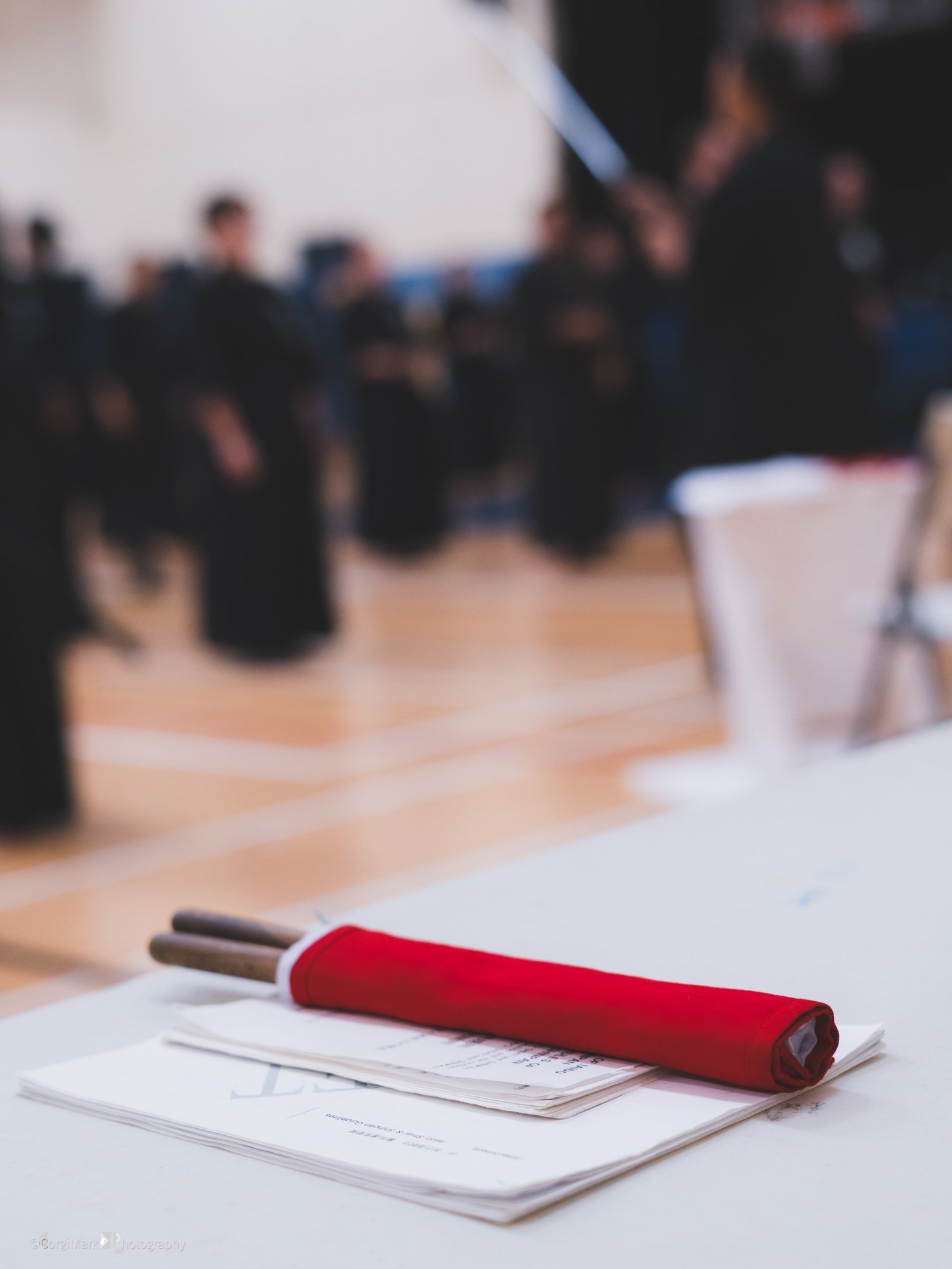
Rules & Regulations
The Canadian National Iaido Championships are conducted under the official rules and regulations established for the event and apply to judges, competitors, and coaches.
The competition is structured to support a national development pathway, celebrate shared standards across Canada, and provide a meaningful forum to demonstrate technical ability and artistic expression in iaido.
Divisions
Competition is organized into Provincial, Regional, and Open divisions, each with its own format and purpose. Competitors may participate in one division only, under the following conditions:
Competitors not selected to a Provincial or Regional team will only compete in the Open division.
Competitors may compete in both Provincial and Regional divisions ONLY if there are insufficient candidates from a given province or region.
All matches are judged according to official Zen Ken Ren shiai embu standards, with final alignment and clarification provided at the Shinpan Seminar on July 17.
Shinpan
Primary shinpan for the CNIC will be CKF 6-Dans and 7-Dans. They will be supported by junior shinpan, 4-Dans and 5-Dans, under the following criteria:
Junior shinpan must compete in one of the brackets at the event (Provincial, Regional, and Open) to be permitted to judge at the CNIC
Junior shinpan must attend the Shinpan Seminar on July 17 to be eligible to judge the Provincial and Regional brackets. Open is ok without attending.
Kata Requirements
Final shitei-waza will be announced during opening ceremonies, and will be structured as follows:
Provincial and Regional Divisions
Senpo and Chuken (Mudansha to 3D) — 5 x ZNKR Shitei Waza
Taisho (4D to 5D) — 2 x Koryu Free Choice + 3 x ZNKR Shitei Waza
Open Division
Open A — Mudansha to 1K — 5 x ZNKR Free Choice
Open B — 1D to 3D — 5 x ZNKR Shitei Waza
Open C — 4D to 5D — 2 x Koryu Free Choice + 3 x ZNKR Shitei Waza
Dress Code
Primary shinpan (6D, 7D) uniforms must be montsuki (kimono top) and white tabi with CANADA zekken.
Junior shinpan and Competitor uniforms must be dogi of the same colour top and bottom (black or white), and wear a dojo or provincial zekken — National zekken are not permitted.
Updated June 26 — Kendo (blue) uniform will be permitted for Mudansha below 1-Kyu. All other competitors with active CKF rank must wear appropriate iaido uniform
Updated June 26 — There will be a few spare fabric + black tape + white marker available onsite to create make-shift zekken — They won’t be ideal, so we encourage those who don’t have a dojo or provincial zekken to order one asap.
Divisions
Provincial Division
Selected by the most senior leaders in each province. Two (2) teams per province
Team Composition
Senpo: Kyu – 1 Dan
Chuken: Up to 3 Dan
Taisho: Up to 5 Dan
Regional Division
Selected by the most senior leaders in each region. Two (2) teams per region
Team Composition
Senpo: Kyu– 1 Dan
Jiho: 2 Dan
Chuken: 3 Dan
Fukusho: 4 Dan
Taisho: 5 Dan
Open Division
Division is open to all competitors not participating in Provincial or Regional divisions
Format
Double Elimination only
No scoring system
Scoring for Provincal & Region Division
Individual Scoring
Individual competitors compete against others within the same rank category in a round-robin format (i.e. all competitors will face others in their divions at least once).
For each match:
Win = 1.00 point
Each flag awarded = 0.01 point
An individual’s final score is calculated as:
Total Score = Total Wins + (Total Flags × 0.01)
These scores are aggregated into a single team score.
Team Scoring
Primary Format
A team’s final result is based on the combined scores of all team members based on the individual scoring rubric.
The team score is calculated as: Sum of all individual member scores
The team with the highest total score is ranked higher.
Alternate Format (if needed)
A team’s result is based on having more wins (at least 2/3 for Province and 3/5 for Region).
Tie Breakers
If two or more individuals or teams have the same total score, ties are resolved in the following order:
1. Total Number of Wins
The competitor or team with the greater number of wins is ranked higher.
2. Head-to-Head Result
If total wins are also equal, the result of the direct matchup between the tied competitors or teams will determine the ranking, where applicable.
3. Daihyosen (Representative Playoff)
If the tie remains after head-to-head comparison, then the Taisho (team captain) will face-off in a single match to determine winner.
Example
Format for Open Division
Double Elimination
In a double-elimination tournament, competitors are not eliminated after a single loss. Instead, a competitor must lose twice before being removed from medal contention.
The format consists of two brackets:
Winners Bracket – for competitors who have not yet lost a match.
Losers Bracket – for competitors who have lost one match.
Competitors who lose a match in the Winners Bracket move into the Losers Bracket and continue competing for a podium position.
A second loss eliminates the competitor from the tournament.
Winners Bracket
All competitors begin in the Winners Bracket.
Competitors continue advancing through the bracket until only two undefeated competitors remain.
These two competitors advance directly to the Championship Match.
Championship Match
The two undefeated finalists compete for:
First Place (Winner)
Second Place (Runner-Up)
Losers Bracket
Competitors who lose in the Winners Bracket are transferred into the appropriate position within the Losers Bracket.
The Losers Bracket provides a second opportunity for competitors to continue competing after their first loss.
Competitors continue advancing through the Losers Bracket until only one competitor remains.
Final Position
The winner of the Losers Bracket is awarded 3rd Place